Friday, March 8, 2013

invisible reflection

I can't seem to create what I have in my head. I think it is because I "feel" it more than "see" it. How can I draw what I cannot see? This blog's quilt comes from internal reflection. It's not inspired directly from a photo, or from an intriguing print on a fabric, or from something I've read or talked about. This is coming from feelings about events that happened in the last few years of my life. How do I get reference for that? Before I can figure out perspective and shape I have to envision the scene better.

I believe that some people see an exact picture in their mind's eye and they set out to create just what they see. Others, like me, have amorphous visions. In creating an artistic expression of my thoughts and feelings, I know whether I am representing truly what's going on in my mind, as it feels right or not, but I'm not making a physical copy of something I'm seeing in my head.

If this quilt idea is not tangible, and I can't "see" it well enough to sketch it out, what will I do?

Tuesday, March 5, 2013

Drawing teacher's critique

The drawings that I made in my sketch book are not satisfying to me. Thinking that my drawing skills are lacking, I have tried meeting with a drawing teacher. The review of what I've drawn is that although I may have a good idea, I need to make some decisions. What is the best placement of the characters to express the things I want to say? How can I use props to emphasize the story? There are a lot of elements I want to include, so how can I make the best use of the space I have available? I need to compose the story before I can record the image.


Friday, March 1, 2013

A magician's quest

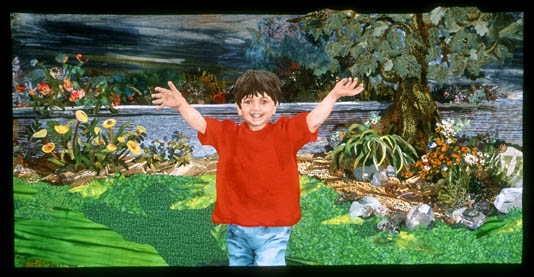
"Exuberance"
Susan V. Polansky, 2007
I am a good copyist. Above is "Exuberance," completed in 2007. I wanted to see if I could capture the bigger than life, bursting with happiness feeling that was so aptly captured in a photo of my son as he turned three years old. I can look at a variety of images, recompose them, and create an interpretation in fabric. My last quilt, "No One but You," captures being caught up in a moment. I used a photo I took when traveling in Buenoes Aires as a starting place, and did extensive photoshop work to create a pleasing composition. I can't wait to show the quilt, but I have to wait until after the Quilt National 2013 show opens before I can post it. I can create realistic images, but I need those images to do more than show technical virtuosity. I am more pleased with my art when it comes from my heart - inspired by something that has emotionally touched me in some way. It is emotional experience that intrigues me the most. The magic of my quilt artistry is to conjure feelings from a collage of fabrics and threads.

"Zach, age 3"
Susan V. Polansky, 2006
"Exuberance" was proof to me that I could translate the captured expression in a photo to a piece created by fabric collage. But it also opened the door to the next desire. The desire to tell a story. I use my own photos, so it is not a matter of copying someone else's image. It is that I want to involve the viewer intellectually as well as emotionally. Depicting an apple accurately is one thing, even if it's an exquisite example, it will stay an apple in my mind. But give me a reason to think about it, and it becomes more than an apple. I can appreciate a beautiful rendition, but art that appeals to me more gets me to ask questions, makes me wonder, or involves me in the scene.


Did you know that the illustrator Norman Rockwell 
wanted to be a movie director if he had not become a painter? 
He had the desire to tell a story! 

Monday, February 25, 2013

The expected, perfected.

My last post talked about spontaneity and planning. Spontaneity can be fun and exciting, or disappointing and discouraging. Planning can be exciting also, but the fun of it can be mired down into drudgery and result in lifelessness. To achieve a combination of the two is my ideal.
How does my creative process lend itself to these opposing forces? 

"Never Mind the Execution"
Susan V. Polansky,  2001

The best answer is to look at an overview of all my work. I never repeat the same thing. In fact, before I ever started using fabric, a college professor wanted me to work in a series. I just couldn't do it. Every painting I did was a "and now for something completely different!" I don't like templates, patterns, variations or the like. I don't get enough out of a re-do. There are many artists that hit upon a successful look, and they repeat that ad infinitum. They can streamline their technique, market the method, become known for their look. 
painted sneakers by 
Susan Polansky
God's Eye trials
Susan V. Polansky, 2006


Modern businesses have perfected the expected. Producing known outcomes is a safe business model. It probably started with production of the Model T, but post-war housing developments and fast food establishments took off and ran with the idea. A proliferation of uniformity creeps everywhere, even into areas where creativity and unique-ness thrived. We've all seen advertised: "Action Figure,"  "A.F. Returns," "A.F. Again!" and so on in the movies. And last I looked, I was surprised by how many adult book titles claim "(some number) of the (trilogy, series, saga.) Not that I haven't indulged in consumption of mass marketing! It's just not what I want for my art. However, having a guaranteed outcome is a much more reliable source of income! I am incredibly fortunate to have a supportive family, which allows me the freedom to spend time in my studio.

Composition: My Reaction to School Violence
Susan V. Polansky, 1999
Over the years, I've experimented with many mediums. I'm curious as to how other artists work. I bring what I've learned forward into each new piece. I can draw from my bag o' tricks whatever technique might serve the piece best. That is how I get lost in the "process." I'm constantly having a dialogue with a work in progress, observing what is working and what needs to happen. I don't feel limited by sticking with any one way of doing something. And I'm not afraid of change. My spontaneity is not a quick burst, but rather a collection of intuitive choices of what "feels" right at the moment. 


Thursday, February 21, 2013

Muscle Memory

Let me first think about some smaller parts to this puzzle.
thinking about how the monuments will look
Here are some pages from my sketchbook, ones that I'm not too embarrassed to show. Drawing is like any motor skill. The muscles remember what to do long after learning the  skills, but practice and exercise is still needed for fluency. I'm a bit rusty. I like Prismacolor drawing pencils. I have a set that ranges from 9B to H. Pencils with a soft lead are B (the higher the number, the softer the lead.) This kind of pencil will make a denser, darker mark, while an H pencil leaves a finer, lighter line.  H is good for invisible guide lines, or very sharp detail. B is good for broader stokes and filling in areas. To force myself to use less detail, I have just bought a 2B graphite crayon, but I haven't used that yet.
I have never been much of a sketch artist - one who can put some quick ideas down on paper. I usually jump right into a project and get involved with details way too early in the game. Then I find that the of effort I put into details in the beginning is often wasted, because the final composition requires something different than I originally had thought. 
after a sketch, I made notes about what I liked or what to change
I also have not done a lot of pre-planning by way of drawings for previous quilts. Either I design as I go along or work with photoshop to compose a picture. In this case, because I have some very definite ideas that I want to express and I know that it's a lot to visually communicate, I know I've got to sort out things before I start with the actual quilt. As a writer makes an outline before delving into their thesis, so I also need to outline my points and be clear to myself what it is I'm trying to achieve.
how should I pose the people?
 
Some artists focus on "process." They get absorbed in working with their materials, taking direction for how to proceed with their work by responding to the outcome of their manipulations. Sometimes it's a "I want to see what happens when I do this or that.." or "I was just playing with (some medium, some idea) and look what happened: let me follow that direction.." It's a wonderful transcendent feeling, to not "think," to be so wrapped up in what you're doing. It's as if a piece is talking to you, saying, "I need this" or "hey, try this over here." It's muscle memory again! The brain is a muscle - it's got to be trained first before it can just work on it's own. Art can be created in a spontaneous manner when there is a grounding of knowing how to respond. Design, composition, balance, focus, perspective and all the other factors in creating art are all being processed in the background. If one weren't considering these elements, then their art is randomness - which may or may not turn out appealing. 

Saturday, February 16, 2013

So, what's the problem?

I had hoped that I could grab some images, collage them together, and - Voila! - it would look great. No such luck. The photocomposition confirms how complicated my idea is, yet at the same time, is "proof of concept." The idea has gone from loose ideas in my mind to something definite I can see on paper. It's a good starting point. The photo presents too many insignificant details that interfere with really "seeing" what is going on in the overall scheme.

My eye does not know where to look. There is no clear focal point, nothing that grabs your attention and draws you in. A good composition has a flow to it, guiding your eye around - but this has no order to it.
something recognizable helps to show 
where you are looking from 

As the photos were taken from different angles, the perspective is not consistant. In the photoshopped image from my Monday 2/11 post, I am looking from above at the two figures in the foreground, yet I seem to be looking at the eye level of the seated man behind them. In any picture, for realism to work, there can only be one eye level.

The entire background is not clear - what is the size of everything? Is it close or far away? The flags do not add any information, they are just adding to visual confusion. If they went from large flags in the foreground to small ones in the distance, it would help define the amount of distance I'm trying to describe. It is understood that each flag is the same size, so if some are very tiny, they must be far away.

I wanted to have groups of people in this quilt, but there is no room for them. Already there is too much going on.

I need to simplify and better define my thoughts.

Friday, February 15, 2013

The monster of my doubt

Am I happy with the photo compositions I posted on Monday?
 Yes and No.
Yes - I like my idea. Seeing images and colors together works as "proof of concept." It starts bringing my imaginations into reality. Yes, this can all work together.
No - I'm too caught up in the fun of photo manipulation. I'm seeing details when that is not what I should be looking for at this stage. I've got all the pieces I need for the puzzle, but how to arrange them?

The monster of my doubt is looming. 

This is too complicated.